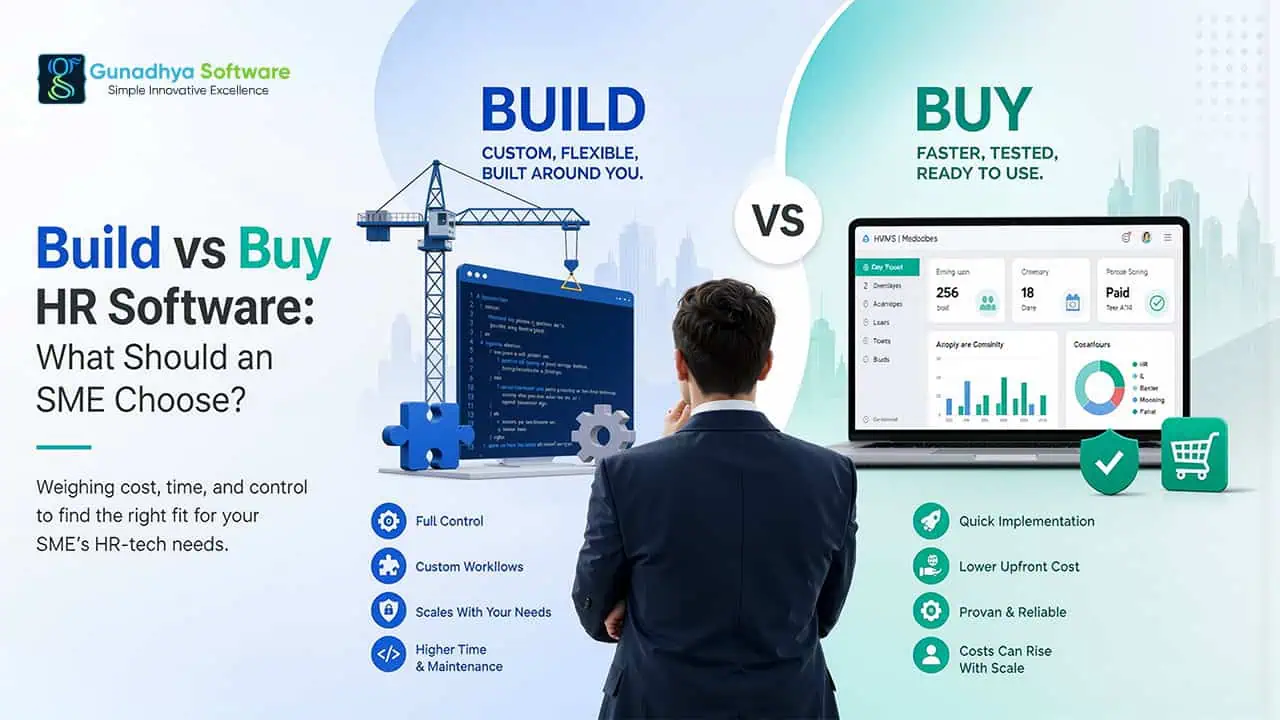
Every growing SME hits the same wall eventually. Spreadsheets stop working. WhatsApp groups stop working. HR processes that once fit in one person’s head now need a system. And the moment that happens, one question comes up: is this a build vs buy HR software decision, or is an off-the-shelf HRMS enough?
There’s no universal right answer to the build vs buy HR software question. But there is a right way to think about it. This post walks through the real trade-offs — cost, time, control, and long-term maintenance — so you can make the call with confidence.
Why This Question Comes Up Now
Most SMEs don’t plan for HR software. They react to pain. Payroll errors start creeping in. Leave approvals get stuck in email threads. Onboarding a new hire takes three different tools and a checklist nobody follows consistently. At some point, the cost of not having a system becomes higher than the cost of getting one.
That’s usually when the build vs buy conversation starts — and it’s usually rushed. A few points below should help slow it down enough to get it right.
What “Build” Actually Means
Building custom HR software means exactly that: a development team designs and builds a system from scratch, shaped entirely around your processes. No generic modules, no unused features, no adapting your workflow to fit someone else’s product.
Where build makes sense:
- Your HR processes are genuinely unusual — multi-entity payroll, non-standard shift structures, industry-specific compliance, or approval chains that don’t map to any off-the-shelf tool.
- You expect to scale fast and need the system to scale with you without re-negotiating licenses or hitting user-count ceilings.
- Data residency, security, or integration requirements rule out third-party SaaS tools entirely.
- You already run other custom internal systems and have (or can access) the engineering capacity to maintain this one too.
Where build gets expensive:
Custom software isn’t a one-time cost. It’s an ongoing commitment — bug fixes, feature requests, security patches, and someone accountable for keeping it running as labour laws and tax rules change. Many SMEs underestimate this second phase. The build is the easy part to budget for; the maintenance is where costs quietly compound.
What “Buy” Actually Means
Buying means adopting an existing HRMS platform — configuring it to your workflows rather than building workflows into it from the ground up.
Where buy makes sense:
- Your HR processes are fairly standard: attendance, leave, payroll, onboarding, performance reviews. Most HRMS platforms already handle these well.
- You need something live in weeks, not months.
- You don’t have in-house engineering bandwidth to own a custom product long-term.
- Predictable subscription costs matter more than full customization.
Where buy falls short:
Off-the-shelf tools are built for the average case. If your business runs on exceptions — a unique incentive structure, a compliance requirement specific to your sector, a workflow that doesn’t fit any dropdown menu — you’ll spend time working around the software instead of the software working for you.
Build vs Buy HR Software: Cost Over Time, Not Cost on Day One
This is where most SMEs get the decision wrong. They compare the upfront cost of building against the subscription cost of buying, and buying almost always looks cheaper on paper.
But that’s an incomplete comparison. The right way to evaluate is total cost over a 3-5 year horizon:
| Build | Buy | |
|---|---|---|
| Upfront cost | High | Low to moderate |
| Time to launch | Months | Weeks |
| Edge Computing | Development + maintenance team | Subscription fees, often scaling with headcount |
| Customization | Full control | Limited to platform’s configuration options |
| Scaling cost | Depends on architecture | Often increases per-user, can get expensive at scale |
| Exit cost | You own the system | Data migration risk if you switch platforms later |
At small headcounts, buy usually wins on cost. As you scale past a few hundred employees, per-user SaaS pricing can catch up to — or exceed — what a well-built custom system would have cost, especially if your processes are complex enough that you’re paying for multiple add-on modules to compensate for platform gaps.
A Third Option: Configured, Not Built From Scratch
Many SMEs assume it’s a binary choice. It isn’t. A growing middle path is working with a development partner to configure and extend an existing HR-tech foundation — getting the speed and lower upfront cost of “buy,” with enough flexibility to handle the specific workflows that off-the-shelf tools don’t cover well.
This is where a lot of Gunadhya’s HR-tech work sits: extending and integrating HR systems around a client’s actual processes, rather than forcing a full custom build or accepting a rigid off-the-shelf fit. If you’re evaluating this route, it’s worth looking at what modern HR platforms already offer before committing engineering budget to build one from zero.
Questions to Ask Before Deciding
Before the decision gets made in a meeting room based on gut feel, run through these:
- How standard are our HR processes, honestly? If 80% of what you need is attendance, leave, and payroll, buy is probably faster and cheaper.
- Do we have in-house capacity to maintain a custom system for years, not just build it once?
- What’s our expected headcount in 3 years? Per-user SaaS pricing changes the math significantly at scale.
- Are there compliance or data requirements that rule out third-party tools?
- Can we get 90% of what we need from an existing platform with light customization, instead of 100% from a fully custom build?
If the answer to the last question is yes, it usually settles the question.
Build vs Buy HR Software:
Build gives you full control at a higher, ongoing cost. Buy gives you speed and predictability but asks you to adapt to the platform’s limits. For most SMEs, the practical answer to the build vs buy HR software question isn’t purely one or the other — it’s finding an HR-tech partner who can configure and extend the right platform around your actual workflows, rather than starting from a blank page or forcing your business into a rigid template.
If you’re weighing this decision for your own organization, it helps to talk it through with a team that’s built and integrated HR systems for companies at different stages of growth — Gunadhya’s HR-Tech services can walk you through what fits your headcount, processes, and budget before you commit either way.