
Rohini Case Study: Building an Accessible Livelihood Platform for Persons with Disabilities
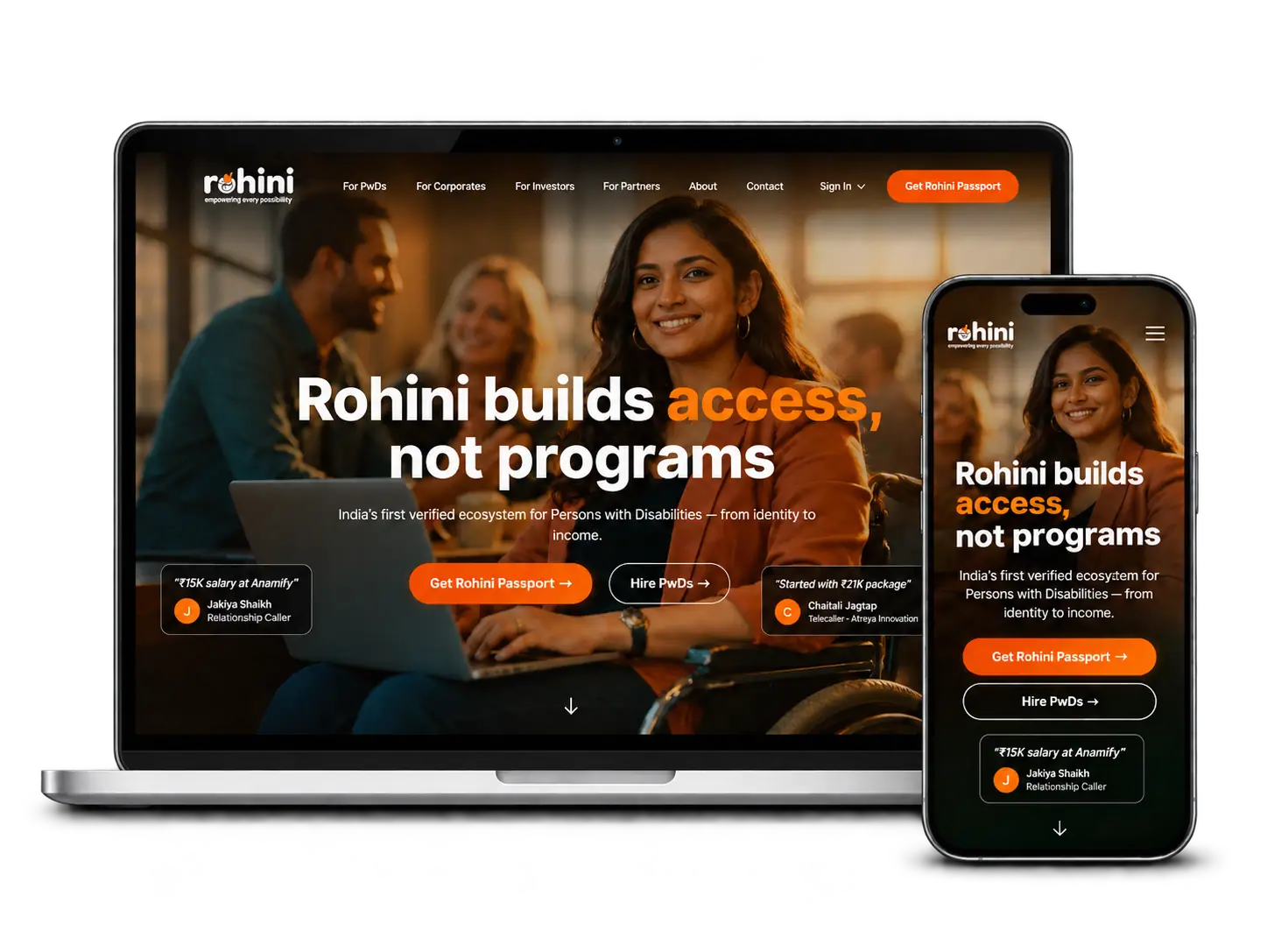
Gunadhya Software Solutions built Rohini for Rohini People Technology, end to end. We designed the platform architecture, built the web platform to WCAG 2.1 AA, and engineered Rohini Passport, a consent-first identity for persons with disabilities (PwD). Rohini now brings PwD identity, livelihood opportunities and inclusive corporate hiring onto one accessible platform.
- Client
- Rohini People Technology
- Industry
- Accessibility & inclusive hiring
- Engagement
- Architecture, platform, identity, ongoing product
- Timeline
- 6 months
- Team
- 4 people
At a glance
- The client. Rohini People Technology, building an integrated platform for India's persons with disabilities.
- The problem. Three audiences (PwD members, corporates, partners) had to share one platform that every member can use, whatever their disability or device.
- What we built. Member registration, Rohini Passport, a livelihood module, and corporate hiring journeys.
- Stack. Next.js, React, Radix UI, Tailwind, Node.js, NestJS, PostgreSQL, Redis, AWS Mumbai.
- Result. Phase 1 live, WCAG 2.1 AA, 100% keyboard navigable.
About Rohini
One platform for identity, income and inclusive work
Rohini is an integrated platform for persons with accessibility needs, run by Rohini People Technology. Members create a Rohini Passport, find livelihood opportunities and apply to inclusive employers. Corporates come to hire PwD talent, meet their inclusion commitments and run accessibility readiness reviews. Rohini also runs on-ground livelihood programmes such as rohinigo, mobile carts operated by PwD entrepreneurs.
What we delivered
Platform architecture
A modular platform designed to add verticals phase by phase without rebuilding the core.
Rohini Passport
A consent-first PwD identity with verification levels and a record of every share.
Livelihood module
Micro-tasks and earning opportunities matched to each member's abilities and location.
Corporate hiring
Employer journeys for posting inclusive roles and tracking PwD hiring.
Accessibility & ops
WCAG 2.1 AA build, assistive-tech testing, and production hosting and support.
The Challenge
Every member, every disability, every device
Most platforms add accessibility at the end. Rohini's users are the people those platforms leave out. A member might use a screen reader on a low-end Android phone, read better in Marathi than English, or navigate by keyboard alone. Every screen had to work for all of them, while corporates and partners got the tools they needed on the same platform.
Rohini's audiences
- PwD members
- Families & caregivers
- Corporate employers
- NGOs & training partners
- CSR funders
Accessible by default
WCAG 2.1 AA across every screen, tested with screen readers, magnification and keyboard-only use.
Sensitive data
Disability details are personal. Members had to control exactly what each employer or partner sees.
Many audiences
Members, corporates and partners each needed their own journey without crowding the others.
Built to grow
Identity, livelihood and hiring had to launch first, with room for training, events and audits later.
Our Approach
We started with the member, then built the platform around them
- 1
Member first
We designed every journey for a PwD member on a basic phone before anything else.
- 2
Accessibility in the components
Accessible components, semantic markup and visible focus from day one, so new screens start compliant.
- 3
Consent as a core feature
Personal data sits apart from the rest, and every share is logged against the member's consent.
- 4
Phase by phase
Registration and Passport went live first. Livelihood and hiring followed on the same core.
- 5
Test with real users
Members and partners tested flows with their own assistive tech, and we fixed what they found.
Product Spotlight
Rohini Passport: one identity the member controls
Rohini Passport is the centre of the platform. It holds a member's profile, abilities, accommodation needs and verification level in one place. Members choose what each employer or partner can see, and the platform records every share.
Step 01
Register
Members sign up by phone in their own language, with every field labelled for screen readers and voice input.
- Phone-based sign up
- Multi-language support
- Screen reader ready
Step 02
Build the Passport
Members add skills, experience, preferred work and the accommodations they need at work.
- Skills and experience
- Work preferences
- Accommodation needs
Step 03
Verify
Members raise their verification level by uploading documents or getting attested by a partner NGO.
- Self-declared
- Documents uploaded
- NGO attested
Step 04
Consent and share
Before any employer or partner sees a profile, the member picks what to share. Every share is recorded.
- Granular consent
- Share logging
- Revocable access
Step 05
Earn and get hired
Members see livelihood tasks and inclusive jobs that fit their abilities and location.
- Livelihood tasks
- Inclusive jobs
- Ability-matched
Illustrative sample member. Names and details are not real.
Results
What we delivered
Technology Stack
What Rohini runs on, and why
Next.js, React
Server-rendered pages load fast on low-end phones and work well with screen readers.
Radix UI, Tailwind
Accessible components with keyboard and screen reader support built in.
Node.js, NestJS
Structured, testable APIs with clear module boundaries for each vertical.
PostgreSQL, Redis
Relational data for members, tasks and employers; personal data kept in an encrypted store.
AWS Mumbai
Data stays in India for residency and compliance.
“They understood the mission from day one.”
Working with Gunadhya Software Solutions on Rohini has been a rewarding experience. The team understood the importance of accessibility and inclusion from the very first conversation, and that showed in every design decision and line of code. We look forward to continuing this partnership as Rohini grows.
FAQ
Frequently asked questions
What is Rohini?
Rohini is an integrated platform for persons with disabilities, run by Rohini People Technology. Members create a Rohini Passport, find livelihood opportunities and apply to inclusive employers. Corporates use it to hire PwD talent and meet inclusion goals. Gunadhya Software Solutions built the platform.
Who built Rohini?
Gunadhya Software Solutions, a Pune-based software company, built Rohini as its technology partner. Our work covered platform architecture, the accessible web platform, Rohini Passport, the livelihood module, corporate hiring journeys and production hosting.
What technology is Rohini built on?
Rohini runs on Next.js and React for the frontend, Radix UI and Tailwind for accessible components, Node.js and NestJS for APIs, PostgreSQL and Redis for data, hosted on AWS in Mumbai so member data stays in India.
How does Rohini meet accessibility standards?
Rohini is built to WCAG 2.1 AA. We use accessible components, semantic markup, visible keyboard focus and readable contrast on every screen, and test flows with screen readers, magnification and keyboard-only navigation.
How does Rohini protect members' personal data?
Rohini Passport is consent-first. Personal and disability data is stored separately from the rest of the platform, members choose what each employer or partner sees, and every share is recorded.
Can Gunadhya Software Solutions build an accessible platform for us?
Yes. We build accessible web platforms, hiring and livelihood portals, and HR tools to WCAG 2.1 AA. We can also audit an existing product for accessibility. Book a call to discuss your scope.
Building an accessible or inclusive platform?
We built Rohini from architecture to production, to WCAG 2.1 AA. Tell us what you're planning and we'll tell you how we'd approach it.