
Gram Panchayat Case Study: Property Tax, Statutory Registers and Certificates in One Offline Desktop App
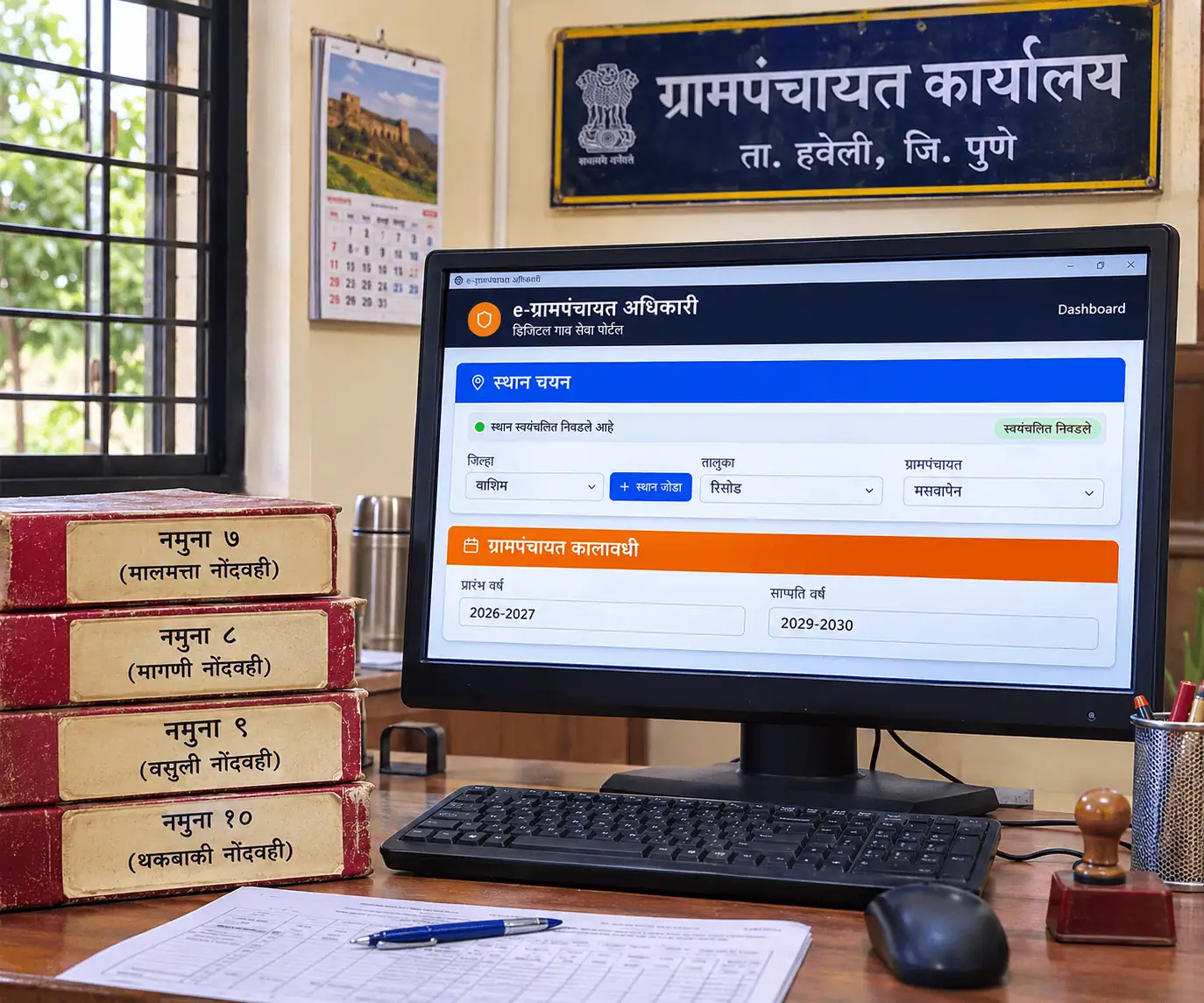
Gunadhya Software Solutions built e-GramSevak (ई-ग्रामसेवक), a Marathi desktop application for Maharashtra Gram Panchayats. It handles property tax assessment using both statutory capital-value formulas, annual demand generation with arrears and penalties, receipt printing, mutation, and all the statutory registers and certificates a Gram Panchayat needs -- fully offline after a one-time licence activation.
- Client
- Contractor agency serving Gram Panchayats in Maharashtra
- Industry
- Rural governance & local self-government
- Engagement
- Desktop application, statutory print templates, licensing, online backup
- Timeline
- 5 months
- Team
- 3 people
At a glance
- The client. A contractor agency that provides software and data-entry services to Gram Panchayats across Maharashtra.
- The problem. Gram Panchayats need property tax assessment, demand generation, receipts, mutation and statutory registers -- all in Marathi, all following government formats, and working offline in villages.
- What we built. A desktop application covering Namuna 7, 8, 9 and 10 registers, two statutory capital-value formulas, seven tax heads, 16 certificate types and online backup.
- Stack. React, TypeScript, Vite, FastAPI, SQLite, Jinja2, Electron-ready packaging, hosted licensing API.
- Result. 4 statutory registers digitised, 100% offline after activation.
About e-GramSevak
Village tax work, done to the government's format
e-GramSevak (ई-ग्रामसेवक) puts Maharashtra's Gram Panchayat property tax process on a computer. It follows the statutory formats for property assessment, tax calculation, demand, receipts, mutation and certificates. The operator works in Marathi, offline, and prints every register and bill in the format the government expects.
What we delivered
Namuna 8
Property assessment register with plot, owner, construction and capital-value details.
Tax engine
Both statutory capital-value formulas, depreciation, use weightage and seven tax heads.
Namuna 9
Annual demand register with arrears carry-forward, penalty, fees and scheme discounts.
Namuna 7
Receipt register for tax payments, printed in the statutory format.
Mutation
Ferfar register and ownership transfer with full audit trail.
Reports
Namuna 10, 8A, tax summary, index register and outward register.
Certificates
16 certificate types with a certificate register and print templates.
The Challenge
Every village has its own rates, and every register its own format
Maharashtra's Gram Panchayats follow the same statutes, but each one sets its own tax rates, slabs and discounts. The software had to encode the statutory process once and let every panchayat configure it. And every printed register, bill and certificate had to match the government format exactly, in Marathi, on a desktop that works without internet.
The tax cycle
- Rate setup
- Namuna 8
- Tax calculation
- Namuna 9
- Penalty/fees/discounts
- Namuna 7
- Registers
- Carry forward
Per-panchayat configuration
Each Gram Panchayat sets its own house tax rate, slab-based taxes, water tax, penalties and scheme discounts.
Statutory print formats
Every register, demand bill, receipt and certificate must print in the exact government-prescribed Marathi format.
Offline-first operation
Village offices have unreliable internet. The application must work fully offline after a one-time licence activation.
Year-to-year continuity
Arrears, penalties and property data must carry forward correctly from one financial year to the next.
Our Approach
We encoded the statutory process, then let each panchayat configure it
- 1
Settings not code
Tax rates, slabs, penalties and discounts are panchayat settings, not hard-coded values. A new panchayat is configured, not programmed.
- 2
Both statutory formulas
The two capital-value formulas from the statute are both implemented. The panchayat picks which one to use.
- 3
Print-ready registers
Jinja2 templates render every register, bill and certificate to the exact government format, ready to print.
- 4
Offline first
SQLite keeps all data locally. The application only goes online for licence activation and optional backup.
- 5
Year-to-year continuity
Year-end carry-forward moves arrears, penalties and property data into the new financial year automatically.
Product Spotlight
The Tax Engine: from plot measurements to a printed demand
The tax engine is the core of e-GramSevak. It takes a property's plot measurements, construction details and building age, applies depreciation and use weightage, runs the chosen statutory formula to get capital value, then calculates all seven tax heads. The result flows into Namuna 9 for annual demand and Namuna 7 for receipts.
Step 01
Enter the property
Plot sides, boundaries, owners, and each construction with its type, size, year built, floor and use.
- Plot measurements
- Owner details
- Construction rows
Step 02
Calculate capital value
Area is converted to sq m, depreciation is looked up from the building's age and type, use weightage is applied, and the chosen statutory formula gives capital value.
Plot: 30 × 40 ft · RCC construction, ground + 1, built 2012
Illustrative sample. Property and figures are not real.
- Area conversion
- Depreciation lookup
- Statutory formula
Step 03
Apply all tax heads
House tax from the GP rate, plus light, health, cleaning and toilet tax by area slab, and water tax by facility.
- House tax
- Slab-based taxes
- Water tax
Step 04
Raise the demand
Namuna 9 pulls every property, adds arrears, penalty and fees, and applies any scheme discount.
- Arrears carry-forward
- Penalty and fees
- Scheme discounts
Step 05
Print and receipt
Print the demand bill or collection register, and issue a Namuna 7 receipt when the holder pays.
- Demand bill print
- Collection register
- Namuna 7 receipt
Results
What we delivered
Technology Stack
What e-GramSevak runs on, and why
React, TypeScript, Vite
A fast, Marathi-first interface with data grids for bulk entry and editing.
FastAPI (Python)
Runs locally on the operator's PC and handles all calculations and print generation.
SQLite
A single local database file that works fully offline and holds data for several panchayats.
Jinja2 templates
Statutory registers, demand bills, receipts and certificates rendered to print-ready pages.
Electron-ready packaging
Installs and runs like a normal desktop application.
Hosted API
One-time online licence activation, then offline use. Online backup copies data to a hosted server.
FAQ
Frequently asked questions
What is e-GramSevak?
e-GramSevak (ई-ग्रामसेवक) is a Marathi desktop application built by Gunadhya Software Solutions for Maharashtra Gram Panchayats. It handles property tax assessment, annual tax demand, receipts, mutation, statutory registers and certificates.
Which statutory registers does it cover?
It covers Namuna 8 (property assessment), Namuna 9 (annual demand), Namuna 7 (receipts) and Namuna 10 (collection), plus the 8A register, Ferfar register, tax summary, index and outward register.
How is property tax calculated?
The system computes capital value using either of the two statutory formulas, applying depreciation by building age and type and a weightage for residential, commercial or industrial use. House tax is the GP rate per ₹1,000 of capital value. Light, health, cleaning, toilet and water taxes come from each panchayat's own settings.
Does it need internet?
Only to activate the licence the first time and to take an online backup. All daily work happens offline.
Can one installation handle several Gram Panchayats?
Yes. The operator selects district, taluka and Gram Panchayat, and each panchayat's data is kept separately in the same installation.
Can Gunadhya Software Solutions build software for our panchayat, municipality or department?
Yes. We build software that follows government formats and processes. Tell us which registers and workflows you need, and we'll show you how we'd put them on a computer.
Still preparing tax registers by hand?
We built e-GramSevak to put statutory registers, tax calculation and certificates on a computer. Tell us which government processes you need digitised and we'll show you how we'd approach it.